
USE CASES
The INSIEME Deployments
Under the leadership of Energy Data Exchange Austria / EDA GmbH, the INSIEME Use deployments are being carried out across several EU countries.
INSIEME's real-world deployments are at the heart of its implementation — treating each pilot not as a demonstration exercise, but as a live ground for data space services, governance models and interoperability standards that Europe's energy system transformation – and in consequence its transition to net-zero - will depend on.
Across 15+ deployments in EU Member States, the project translates regulatory ambition into operational reality, stress-testing data exchange scenarios with actual grid operators, energy communities, service providers and residential as well as industrial consumers. The seven deployment categories below illustrate the breadth of this effort, spanning from household carbon footprints to AI-assisted transmission planning.
TASK 4.2
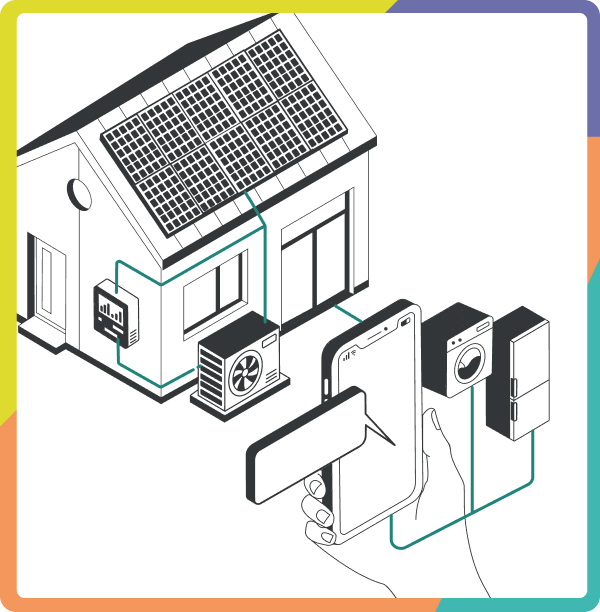
Household energy footprint & savings
The bigger picture – the impact on everybody’s carbon footprint
EU buildings account for 40% of its energy consumption, while most households have no clear picture of their personal carbon footprint. This INSIEME deployment, in form of 2 applications, helps consumers to better understand electricity consumption and local energy generation through an easy-to-use application. In parallel, it enables energy service providers to securely access household metering data — via the energy data space — and calculate its real-time CO2 emissions, empowering consumers to act on consumption, emissions and costs. Both applications increase awareness and lead in consequence to more sustainable EU buildings - in line with the EU Directives on Energy Efficiency, on Energy Performance of Buildings and on Green Transition Consumer Empowerment.
Brought to you by INSIEME and the CEEDS
The ECLIPSE application, developed by INSIEME partner ETRA, analyses consumption patterns and household energy prices, providing personalized recommendations to help lower energy use and electricity bills. Innovation is brought to households through features that allow to estimate the consumption of individual appliances, without requiring additional sensors or metering devices. This helps detect inefficient or malfunctioning appliances, and issue tailored recommendations.
ECLIPSE ProjectSavingsFootprint is an application prototype further that is developed under INSIEME, with the main feature to present carbon footprints to consumers and recommend adjusting consumption patterns, shifting flexible loads, or joining demand response campaigns. The objective is to make the application available in Poland, Latvia and Lithuania, with the CEEDS seamlessly integrating and connecting data hubs in these 3 countries (and across others in the future!), feeding data from various sources, e.g. from district heating/cooling, mobility, or energy content of various purchased goods and services.
TASK 4.3
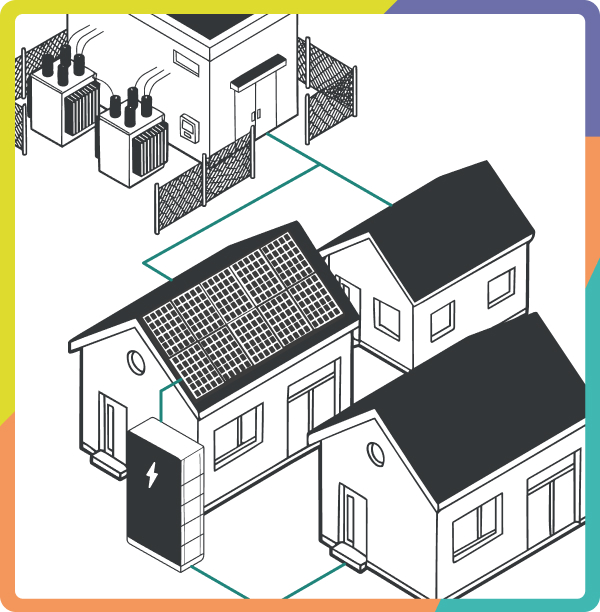
Energy communities & collective self-consumption: Enabling citizens and businesses to produce, share and self-consume
Act INSIEME, right now!
Community energy allows citizens, SMEs and local authorities to collectively produce, store and share renewable energy — reducing costs, emissions, and grid dependency. Renewable as well as Citizen Energy Communities, as established by EU rules, are outstanding instruments in the bottom-up transition to decentralized and decarbonized energy systems that deliver for our citizens. In MS where implementation has progressed substantially, such as Austria or Spain, sustainable eco-systems are thriving – yet still today, platform solutions are built separately for each and every national context.
Brought to you by INSIEME and the CEEDS
This is why INSIEME brings together energy community / technology operators from several EU MS, to implement an interoperability layer that allows service providers to develop solutions once, and operate and compete on all supported markets, enhancing collective self-consumption, energy market data integration (of RECs / CECs), and energy sharing. This effort goes beyond national borders and contexts, scaling solutions and applying available platforms across multiple countries (and at European level in the future). This is done by developing a reference model and extending the framework established as part of the EDDIE project.
EDDIE ProjectThis INSIEME deployment covers the full lifecycle of a Collective Energy Sharing Unit (CESU): from legal registration and technical onboarding of new members (with their consent at its core) to continuous data collection, self-consumption optimisation, and financial settlement. Data exchanges span the entire chain — DSO validation, smart meter reads, dispatch of flexible resources (batteries, EVs, heat pumps), and monthly billing reconciliation. The deployment also supports Flexible Connection Agreements, allowing the DSO to temporarily limit feed-in during times of network constraints, and market-based flexibility monetisation for energy surplus.
TASK 4.4
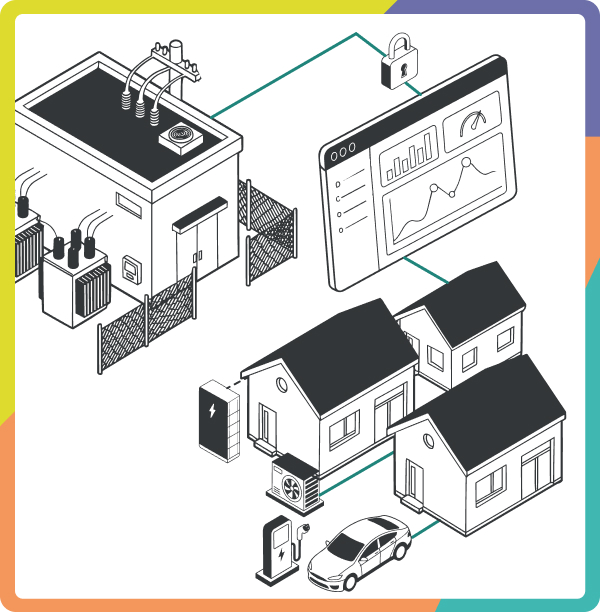
Local flexibility services: Solving grid congestion through coordinated distributed resources
Improve the efficiency of network development and operations
With the progression of electrification, grid operators increasingly face local congestion and voltage issues. As flexible resources multiply, they can increasingly mobilize new means to solve such issues and improve the efficiency of network development and operation and strengthen Europe’s electricity system - which is prerequisite to our transition to net-zero. In its deployments, INSIEME structures the data exchanges needed for four complementary flexibility mechanisms: Flexible Connection Agreements (FCAs, curtailment per connection agreement point), collective limitations (curtailment over a group of connection agreement points, split and managed by an aggregator), local flexibility services (procured by system operators from service providers), and grid prequalification and later temporary limits – all of which helps avoiding that flexibility activation causes grid issues.
In all cases, the shared data object embeds a technical parameter — typically a power time series — flowing between the system operator, aggregators, and controllable units, enabling forecast, real-time response and observability of the targeted flexibility. The developments pave the way to implement new EU rules (such as the Network Code on Demand Response) that are designed to help make electricity networks smarter and more flexible. INSIEME complements the harmonized reference models defined for the Implementing Act on Interoperability for Demand Response, by developing such models and data exchange standards to use local flexibility and interfaces with market platforms. Within INSIEME, experts and partners who are experienced in implementing such structures, align, test and validate solutions in a common European approach, instead of creating isolated national or regional systems.
Brought to France, Austria and Rome
by INSIEME and the CEEDS
Enedis, Europe’s largest DSO, Areti (the DSO of Rome), the Lower Austrian Grids, Styrian grids, and APG (Austria’s TSO) are developing a European harmonized reference model for FCAs and deploy schemas and interoperable digital customer interfaces for the communication and distribution of flexible connection limits. Integrated into the landscape of European standards, existing information models like IEC 62325-351 and IEC 62746-4 are improved to fulfil the foreseeable requirements indicated by European Electricity Market Redesign and EU Network Codes. The deployment taps into existing smart meter real-time interfaces and establishes schemas compatible with and without service providers.
APG and other European TSOs are joining forces to provide a streamlined European interface for service provided based on the IEC 62325 family of standards, to allow for flexibility service providers to enroll in local and balancing markets.
Rome’s DSO Areti runs the “flexibility from small assets” deployment, encompassing 6 HV/MV stations, 6 MV lines and approx. 100 MV/LV substations. INSIEME’s ambition is to upscale the digital flexibility marketplace and turn it into an open and fully replicable application so many flexibility providers and services can benefit from Rome’s local flexibility market.
TASK 4.5
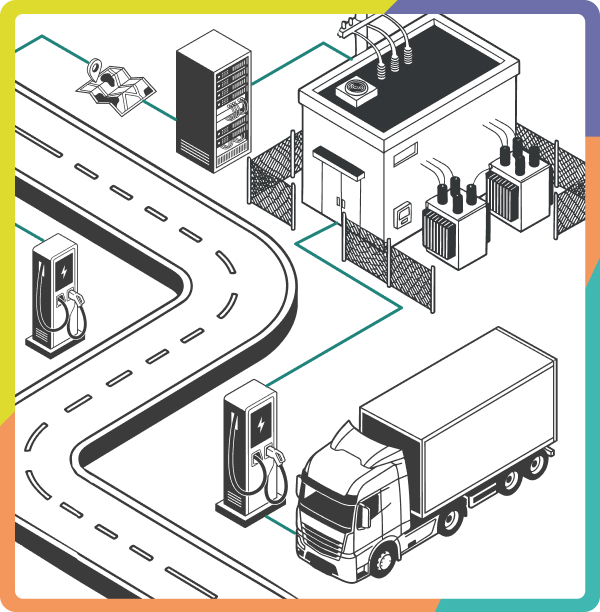
Long-term grid hosting capacity & heavy-duty EV charging
Planning tomorrow's networks with today's mobility data
The rapid development of e-mobility presents several new challenges and opportunities for the energy system, whilst the recharging ecosystem for heavy-duty electric trucks differs significantly from the requirements of residential smart charging. Yet investors and fleet operators lack visibility into where and when grid capacity will be available. Fleet management and route planning systems and Distribution System Operators connecting recharging infrastructure have a pressing need to share data between one another to prepare grid capacities for charging proceedings, and improve transportation schedule to available capacities (which are essential in heavy-duty transport, due to tight delivery schedules that respect supply chains and other logistic requirements (like in fresh food industries). This places a special challenge with regards to the definition and implementation of interfaces between Mobility and Energy Data Spaces.
This INSIEME deployment focuses on the bidirectional data exchange between system operators and electromobility stakeholders: operators publish forward-looking grid hosting capacity maps (as now required by EU regulation 2024/1747), while mobility players contribute GPS tracks and historical charging profiles to help operators model future demand. The result is a shared, data-driven planning layer that reduces connection request delays, de-risks infrastructure investment, and accelerates the clean transport transition.
Brought to you by INSIEME and the CEEDS
Vattenfall, Volvo Technology and Renault are piloting a short-term and long-term data-sharing ecosystem in Sweden, proposing European reference models and uplifting European information model standards with the necessities of the integration between heavy-trucks recharging and grid operation in that sense. In this context, the cross-sector transversal issue of claim management among sectoral data spaces and the interfaces in between them are being addressed.
The “Open Thor Living Lab Smart Charging”, set up by the INSIEME partner EnergyVille, is Flanders’ only regulatory sandbox and fosters innovation engaging authorities, the private sector and citizens. The INSIEME deployment make use of 44 EV charging points (most supporting 22kW AC), with the ambition to overcome challenges in smart charging and flexibility services by integrating car apps, charging platforms, and EAN objectives. Supported by the EnergyVille cloud platform for combining weather forecasts, energy markets, real-time measurements and historical data, this deployment focusses on maximizing user comfort and ensuring reliable flexibility through better prediction and asset management.
TASK 4.6
Renewables Integration
Short, medium or long term – data for improved energy systems that run on renewables
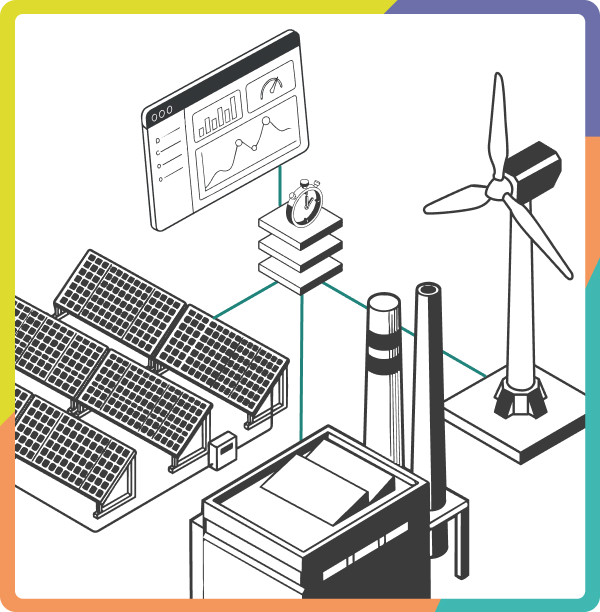
Data sharing supports medium- and long-term planning and short-term operational efficiency for energy networks. Shared data on generation, demand, conversion, and storage informs long-term scenarios and supports research and planning. In the short term, this INSIEME use case enables better decision-making, maintenance coordination, load balancing, and disruption response. In the medium term, it facilitates sophisticated planning models and simulations and helps design investment strategies and integration of new technologies. And in the long term, it supports sustainable and resilient energy networks, integrating renewable energy and smart grid technologies.
Brought to you by INSIEME and the CEEDS
Used in many related EU projects, spatial-temporal hierarchical data spaces allow for an optimal operation of many energy systems services. Led by the Technical University of Denmark, the hierarchical smart energy operating system framework is designed, amongst others, for optimized TSO-DSO coordination, next generation of load forecasting in district heating, as well as for the efficient activation of flexibility in complex assets like clusters of buildings and wastewater treatment plants. Data is provided by the Danish TSO (Energinet), DSOs, wind farm owners as well as the district heating operator in Copenhagen demonstrating the benefits of temporal hierarchies for improved forecasting. In parallel data from Trefor, the DSO of the Danish city of Kolding, does the same for a number of buildings for providing flexibility services for both electricity and heating grids.
TASK 4.7
AI-assisted grid operation & network planning: Sovereign data sharing between system operators and AI providers
Network operation powered by AI
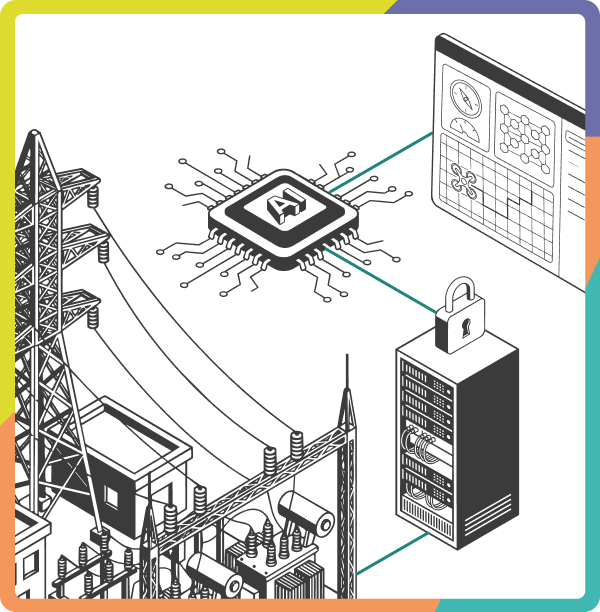
Network operators hold vast operational datasets that AI can turn into powerful planning tools — but sharing that data with external technology providers raises legitimate concerns around sovereignty, cybersecurity and IP. This deployment defines the legal, technical and governance framework for a System Operator to collaborate with an AI provider on day-ahead grid planning, while retaining full data control. In parallel, it addresses the coordination challenge between DSOs planning network expansion and private energy/flexibility service providers sizing distributed resources — proposing a co-optimisation scheme that balances regulated infrastructure investment with market-driven DER deployment, potentially serving as a regulatory sandbox for national authorities.
Brought to you by INSIEME and the CEEDS
Led by the National Technical University of Athens, the INTERFLEX deployment disseminates improved data-centric models and services, enhancing building interaction with energy markets, optimising flexibility markets, and developing efficient cross-sector energy trading. Integrated into the implementation of INSIEME, INTERFLEX leverages novel data models, IoT-edge-cloud continuum, and AI/ML for low-cost digitalization of energy systems through intelligent energy services. INTERFLEX interacts with the Greek transmission grid (through existing energy markets) and distribution grid integrating data from households, commercial, and industrial buildings, providing data from integrated and real-time flexibility services.
The INSIEME partner Enlite.ai is a DeepTech Venture Studio that develops next level ML/AI based grid management co-pilots to assist TSOs/DSOs on taking complex decisions, with regard to cost-effective, carbon-free grid control actions, enhanced grid reliability, flexibility, and renewable energy integration. The system utilises active topology control to alleviate congestion and optimize grid performance, reducing reliance on costly measures and fossil fuels. It offers benefits across planning stages, from long-term contingency planning to real-time operational support. Under INSIEME, Enlite.ai teams up with key DSOs to use Deep Reinforcement Learning technologies and extend the solution to lower-level networks and link digital twin technologies with the CEEDS, with the purpose of providing European-wide interoperable digital solutions for DSOs.
The INSIEME deployment “Portuguese Electricity and Gas Networks for Integrated Planning and Operation” demonstrates the CEEDS’s capability to enable secure and trusted data exchange between TSOs, DSOs, and energy communities, for an efficient and effective cross-sector integration and coordinated infrastructure planning and operation. Led by REN, Portugal’s TSO, data is being exchanged across the gas and electricity sectors, relying on assets and data sources that include thousands of kms of transmission lines and pipelines, many substations, connection points and smart meters. The objective is, amongst other, to improve coordinated infrastructure planning by using digital twins, reduce costs and enhance network security.
TASK 4.8
Sector integration & cross-domain data integration: bridging energy with other data domains at scale
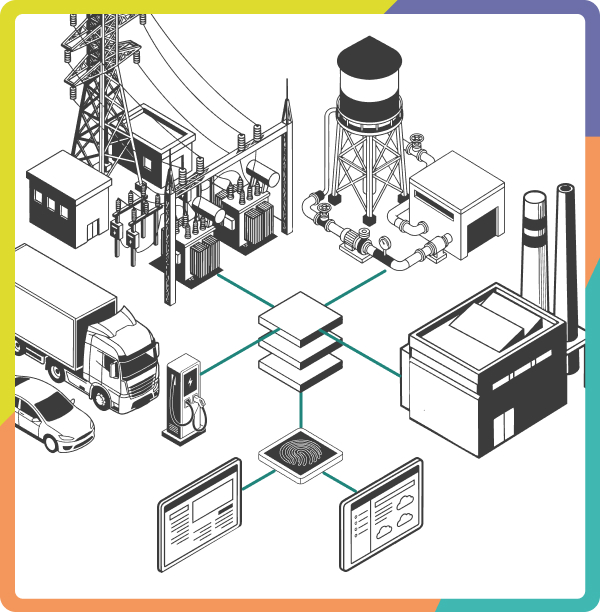
Smart sector integration coordinates the electricity system with other sectors, leveraging low-carbon power generation for efficient energy use. Key data elements stem from energy conversion, processing, consumption, storage, and transportation. In the 2050 vision of the European Technology & Innovation Platform for Smart Networks for Energy Transition (ETIP SNET), several functionalities are needed for smart sector integration, such as flexibility from generation, demand, and storage, local energy markets, and digital services. In return, this requires substantial data integration and connecting platforms, as well as procedures and stakeholders from a range of sectors such as water, gas, electricity, heating, mobility and others. Thus the full value of an energy data space emerges when energy data is combined with data from adjacent sectors.
Brought to you by INSIEME and the CEEDS
This Denmark-based INSIEME deployment builds a reference implementation of cross-sectoral data space principles at national scale. It develops identity management and consent modules capable of handling 30+ different data providers across sectors, with a streaming infrastructure processing data at 1-second granularity and exposing over one million household data points. The deployment aims to demonstrate how a common data model and data space governance can unify fragmented national data silos into a coherent, interoperable foundation for the energy transition.